Best AI Music Video Generators 2026: Full-Song Tools Compared
Compare the best AI music video generators for full songs, lip-sync, audio upload, pricing, editing effort, and YouTube/social export workflows.
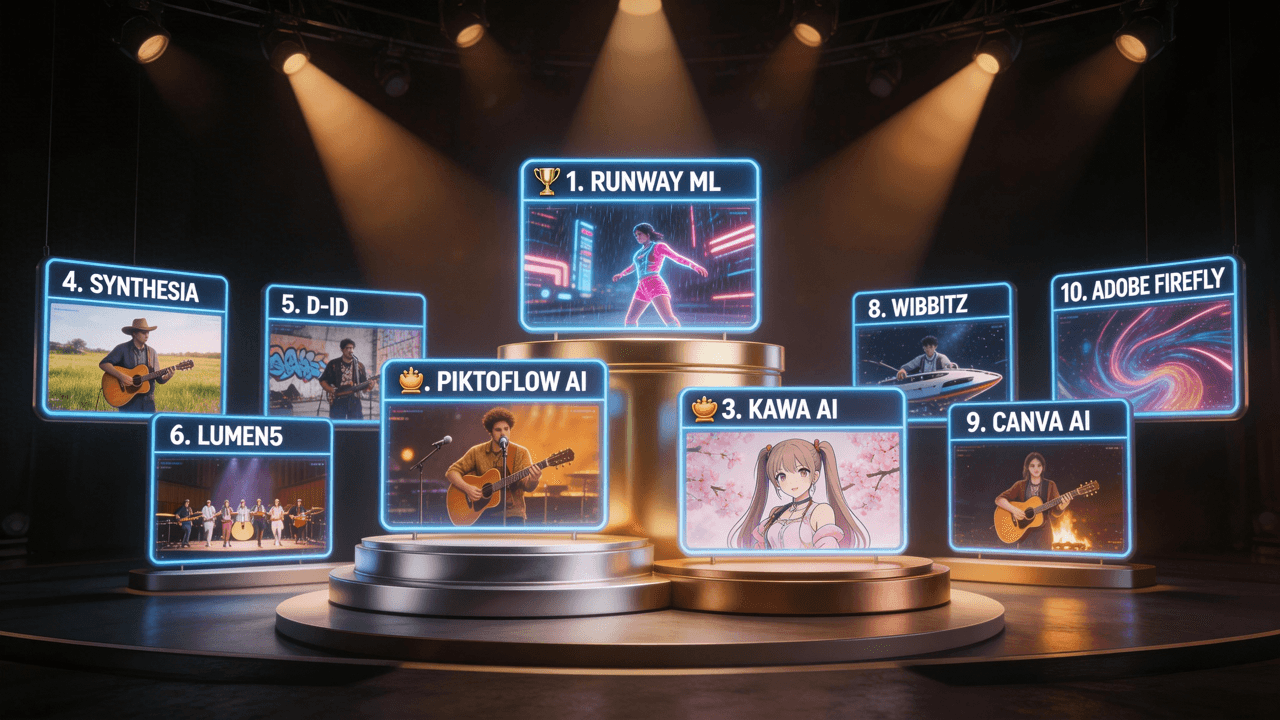
Last reviewed: May 12, 2026. This guide is written for musicians, producers, labels, and creators comparing AI tools for actual music-video workflows, not just generic AI video clips.
Quick answer: the best AI music video generator for full songs is VibeMV if you want to upload a finished track and generate an assembled music video with automatic song segmentation, beat-aware pacing, editable scenes, and optional singing lip-sync. For high-volume music-video modes, compare Freebeat. For cinematic AI clips you will edit manually, compare Runway, Pika, Luma, Kling, and Sora. For abstract audio-reactive visuals, compare Neural Frames.
The key question is simple: do you need a complete song-to-video workflow, or do you need short AI clips to edit yourself? Music-specific tools should handle audio upload, section planning, vocals, aspect ratio, and final assembly. General AI video tools can create strong shots, but you still need to assemble and sync the music video in an editor.
Use this comparison to choose by workflow, not just demo quality. We focus on the things musicians usually need before paying for credits: audio upload, full-song assembly, lip-sync fit, beat sync, export formats, pricing clarity, and how much manual editing is required.
Best AI Music Video Generators at a Glance
| Use case | Best fit | Why |
|---|---|---|
| Upload a finished song and generate a complete MV | VibeMV | Music-specific audio upload, segmentation, optional lip-sync, 16:9/9:16 output, and final assembly in one workflow |
| Create many social/music-video variants | Freebeat | Multiple music-video modes are useful when volume and format variety matter |
| Generate cinematic AI clips for manual editing | Runway | Strong creative controls for clip generation, but audio sync and assembly stay manual |
| Create electronic or ambient audio-reactive visuals | Neural Frames | Better fit for abstract visuals that react to audio rather than character performance |
| Test low-cost short AI clips | Pika / Luma / Kling | Useful for quick clips, but less complete for full-song music-video workflows |
If you only remember one rule, use a music-specific generator when the source asset is a complete song. Use a general AI video generator when the source asset is a shot idea that you plan to edit manually. That single distinction explains most of the differences in cost, time, and output quality.
Ready to make the video instead of comparing tools? Open the AI music video generator to upload a song and create a complete MV, or use the music visualizer if you only need a quick audio-reactive promo clip.
Choose by Search Intent
Search results for "best AI music video generator" mix full-song generators, short AI video models, visualizers, and social editors. Use the query behind your search to pick the right path:
| Search intent | Best next page | Why |
|---|---|---|
| "I want to upload a finished song and create a full MV" | AI music video generator | Product workflow for audio upload, song segmentation, optional singing lip-sync, and 16:9 or 9:16 export |
| "I need a comparison before choosing a tool" | This guide | Workflow-fit comparison across music-specific tools, clip generators, visualizers, and editors |
| "I have an MP3/WAV and need upload limits" | AI music video from audio file | File formats, 100 MB limit, 3-second to 5-minute range, credits, and audio prep |
| "I only need a free or no-watermark test" | Free AI music video generator options | Explains free credits, watermark boundaries, personal testing, and when to upgrade |
| "I need TikTok/Reels/Shorts assets" | Best AI platform for social media music videos | Focuses on 9:16 output, hook clips, social cutdowns, and manual finishing work |
Which guide should you read next? This is the comparison hub. If you want the creation workflow after choosing a tool, read How to Make a Music Video with AI or AI Music Video from Audio File. If budget is the main filter, compare the free AI music video generator options. If your release is social-first, read Best AI Platform to Make Music Videos for Social Media. If you want the music-focused product page, go to the AI music video generator.
Top Companies for AI-Generated Music Videos
If you are comparing companies rather than individual features, the practical shortlist is:
| Company / product | Best music-video fit | Main limitation |
|---|---|---|
| VibeMV | Finished-song uploads, segment-based generation, optional singing lip-sync, release-oriented 16:9 and 9:16 outputs | Focused on music videos, not general filmmaking controls |
| Freebeat | Multiple music-video modes for creators who need many variants | Credit model, mode access, and output consistency need a test with your own song |
| Neural Frames | Audio-reactive visuals for electronic, ambient, and abstract releases | Not a lip-sync or character-performance workflow |
| Runway | High-control AI clips for editors and directors | Full-song music sync and assembly stay manual |
| Pika, Luma, Kling, Sora | Short AI video clips and visual exploration | Not complete song-to-video pipelines |
For most musicians, the first decision is not "which model looks best in a demo?" It is "do I need a complete music-video workflow, or do I want clips to edit myself?" A complete workflow should handle audio upload, sections, vocals, aspect ratio, and final assembly. A clip generator can still produce excellent visuals, but you need a separate editing process to make it behave like a music video.
Quick Comparison Table
| Tool | Best For | Full-Song Workflow | Music Lip-Sync | Manual Editing Needed | Best Fit |
|---|---|---|---|---|---|
| VibeMV | Finished-song to complete MV | Yes, up to 5 min | Yes, music-focused | Low | Independent musicians with vocals |
| Freebeat | High-volume music-video modes | Yes, mode-based | Yes, Singing MV | Low-Medium | Creators making many variants |
| Runway | Cinematic AI clips | No, clip-based | Speech/dialogue tools | High | Filmmakers and editors |
| Neural Frames | Audio-reactive visuals | Yes, visualizer-style | No | Medium | EDM, ambient, experimental |
| Kaiber | Artistic animation | Partial / clip-based | Image/video lip-sync tools | Medium | Abstract or stylized videos |
| Pika Labs | Fast short AI clips | No, clip-based | Per-clip tools | High | Budget clip generation |
| Luma Dream Machine | Cinematic short clips | No, clip-based | No | High | Manual music-video assembly |
| Kling AI | Longer AI video clips | Partial, still manual | Native sync tools vary by version | Medium-High | Longer clip generation |
| Sora (OpenAI) | Premium prompt-to-video clips | No, clip-based | No music workflow | High | Visual exploration and b-roll |
| Steve AI | Template videos | Template-based | No | Medium | Simple promo videos |
This table compares music-video workflow fit, not final output quality from a controlled benchmark.
How We Compared These Tools
We compared the category around music-video workflow fit rather than generic AI video quality. A tool is more useful for musicians when it can reduce the amount of external editing needed between "song file" and "publishable music video."
The main criteria:
- Audio input: Can you upload an MP3, WAV, AAC, M4A, or similar finished track?
- Music analysis: Does the tool detect beats, vocals, sections, or energy changes?
- Full-song assembly: Does it create a complete music video, or only isolated clips?
- Lip-sync fit: Is lip-sync built for singing/vocal music, speech, static images, or not available?
- Manual editing effort: Do you need a separate video editor to align clips to audio?
- Output formats: Can you make both 16:9 YouTube videos and 9:16 vertical cutdowns?
- Pricing clarity: Can a musician estimate the cost of one song before generating?
This is intentionally conservative. We only call something a controlled benchmark after using the same inputs, prompts, and scoring rubric across each platform.
We also separate evidence levels:
- VibeMV product facts: upload formats, duration limits, credits, output options, and workflow behavior that we can verify directly.
- Public competitor positioning: features, modes, pricing models, and limits described by each competitor or public documentation.
- Editorial workflow fit: our judgment about which tool best fits a musician's use case, based on the criteria above.
Key Takeaways
- Best for complete song-to-MV workflow: VibeMV because it combines audio upload, segmentation, optional lip-sync, and final assembly in one music-specific pipeline
- Best for high-volume music variants: Freebeat because it offers multiple music-video modes for creators making many versions
- Best for cinematic clip generation: Runway because it is built for professional AI video clips, though full songs require manual assembly
- Best for electronic and abstract visuals: Neural Frames because its value is audio-reactive visual generation, not character performance
- Best budget testing path: Start with free tiers or short test clips, then compare the result on your own song before paying for full-length output
- Most important decision: Decide whether you need a complete music-video workflow or only AI clips you will edit yourself
Individual Tool Reviews
1. VibeMV
VibeMV is one of the few AI music video tools built specifically for independent musicians who need automatic lip-sync integrated into a full-song pipeline. The platform combines smart audio analysis, character-driven visuals, and segment-by-segment customization in a single workflow designed for music.
Key Features:
- Smart audio segmentation with automatic vocal detection
- AI lip-sync technology optimized for singing voices (not speech)
- AI Director for automatic storyboard generation and style guidance
- Segment-by-segment video customization with independent control
- Support for MP3, WAV, AAC, and M4A audio formats
- Both 16:9 landscape and 9:16 vertical format output
- Up to 5-minute video generation in single project
- Free release tools around the core generator: lyric video maker, music visualizer, MP3 to video converter, Spotify Canvas maker, AI album cover generator, album name generator, song title generator, and band name generator
Strengths: VibeMV excels because it treats music differently from generic video generation. The platform automatically detects where vocals appear, applies music-optimized lip-sync to those sections, and generates standard visuals for instrumental parts. This segment-based approach enables creative flexibility — you can customize each section independently while maintaining automated efficiency. The full-song pipeline reduces the external editing needed to sync visuals with audio. For independent artists, this workflow saves hours compared to assembling short clips in a general-purpose editor.
If you are not ready to render a full AI music video, VibeMV's free tools cover the lighter release assets that musicians usually need first. Use the AI album cover generator for square artwork, the free lyric video maker for synced lyric videos, the music visualizer for beat-reactive social clips, and the MP3 to video converter when you only need a cover-art visualizer from an audio file.
Limitations: Higher starting price than general-purpose clip tools. No camera controls or motion brush tools like Runway. Focused entirely on music, so it is not the right choice for non-music projects or filmmakers who want shot-by-shot cinematic control more than automation.
When VibeMV is not the right choice: Choose a general AI video tool instead if you mainly need cinematic b-roll, non-music video scenes, precise camera controls, or short clips you plan to edit manually. Choose Neural Frames instead if you want abstract audio-reactive visuals without characters or lip-sync.
Best For: Independent musicians releasing singles, content creators making lyric videos, and artists who want character-driven music videos with automatic lip synchronization. Ideal for pop, rap, R&B, and acoustic genres where lip-sync authenticity drives engagement.
Pricing: Free tier for testing. Paid plans start at $19/month for regular creators. One-time credit packages are available for occasional users. Current VibeMV exports are watermark-free; verify current plan, credit, and commercial-use rules before using any AI video tool for a public release.
Verdict: Best choice if automatic lip-sync for singing voices is your primary requirement.
Learn more in our complete guide to AI lip sync for music videos.
2. Freebeat
Freebeat is one of the most visible music-focused AI video tools and publicly positions itself around high-volume music video creation. The platform offers multiple video modes (Singing MV, Storytelling MV, Abstract MV, Viral Shorts, Lyrics Videos, Dance Videos), making it useful for creators who want several content variants from the same track.
Key Features:
- 6 specialized video generation modes optimized for different music genres
- Singing MV mode for vocal lip-sync
- Real-time BPM detection and multi-level structural song analysis
- Beat-to-visual synchronization features
- Consistent character/avatar generation across scenes
- Storytelling MV mode for narrative-driven visuals
- Abstract MV for psychedelic/electronic music
- Viral Shorts mode for TikTok/Instagram content
- Built-in Lyrics Video generator with automatic lyric display
- Dance Video mode with character movement sync to rhythm
- Publicly reported creator/community scale
- Yamaha Creator Pass partnership for professional musicians
Strengths: Freebeat's competitive advantage is mode diversity. Unlike single-pipeline tools, it offers specialized workflows for different creative needs. Singing MV is the relevant mode for vocal tracks, while Viral Shorts and Lyrics Videos serve social and lyric-video use cases. For high-volume creators managing multiple projects across genres, these modes can reduce tool-switching. Yamaha partnership signals institutional credibility in the music industry.
Limitations: Quality inconsistency reported by users — identical prompts produce noticeably different results. Generation failures on complex or ambiguous prompts. Credit system with no rollover, creating subscription waste. Mobile interface not fully optimized for phone creation.
Best For: Content creators managing high-volume music video production across multiple genres. Music labels evaluating distribution content at scale. Producers who need Viral Shorts mode for TikTok/Instagram release strategy. Artists with access to Yamaha Creator Pass seeking professional-grade tools.
Pricing: Freebeat uses a credit/subscription model with free and paid tiers. Before choosing it, check the current credit allowance, watermark policy, duration limits, rollover rules, and which modes are included in your plan.
Verdict: Best choice for creators who need multiple video modes and can tolerate quality variance in exchange for production speed.
Read our detailed Freebeat vs VibeMV comparison for a focused feature comparison.
3. Neural Frames
Neural Frames takes a fundamentally different approach to music videos: instead of character-driven narratives, it generates abstract visuals that respond to your audio in real time. Built on Stable Diffusion, the tool creates psychedelic, morphing animations synchronized to beat and frequency data.
Key Features:
- Audio-reactive visual generation (responds to beat, frequency, energy)
- Multiple artistic style models (psychedelic, abstract, generative)
- Real-time preview and iteration capability
- Stable Diffusion backbone for unlimited style control via prompt engineering
- Full-length track generation (no clip limits)
- Supports both audio upload and YouTube/Spotify links
- Customizable color palettes and visual intensity
- BPM and frequency bin visualization
Strengths: Neural Frames produces visually striking, hypnotic abstract content that genuinely pulses with musical energy. The audio-reactivity creates an organic connection between sound and visuals that feels intentional rather than random. Stable Diffusion backbone provides near-unlimited aesthetic control through prompt engineering. Full-track generation without segmentation makes it ideal for ambient and electronic music. The real-time preview loop accelerates iteration significantly compared to waiting for full renders.
Limitations: No lip-sync capability whatsoever. Output tends heavily toward psychedelic and abstract aesthetics — poor fit for musicians wanting realistic characters or narrative visuals. Moderate learning curve for effective prompt engineering to achieve desired styles. Not suitable for artists wanting traditional music video aesthetics. Generated content may feel too abstract for mainstream pop/hip-hop audiences. Pricing can overlap with music-focused tools despite the narrower visualizer-style use case.
Best For: Electronic music producers, ambient artists, and experimental musicians who want reactive visual art rather than narrative music videos. Live performance VJs needing real-time synchronized visuals. Producers creating content for psychedelic or meditation-focused platforms.
Pricing: Paid plans are available for higher generation capacity and output options. Check current limits before using it for a release schedule.
Verdict: Best choice if your music is electronic/ambient and you want reactive abstract visuals rather than characters.
For detailed comparison, see our Neural Frames vs VibeMV analysis.
4. Runway ML
Runway has established itself as a professional-grade AI creative suite for filmmakers and editors. The platform's video generation capabilities are strongest when you want cinematic clips, camera control, and a broader post-production workflow rather than an automatic song-to-video pipeline.
Key Features:
- Advanced video generation models for text-to-video and image-to-video workflows
- Text-to-video generation from detailed prompts
- Image-to-video transformation with motion synthesis
- Professional editing timeline and compositing tools
- Speech/dialogue-oriented lip-sync tools for short clips
- Camera control and motion customization
- Inpainting and selective region editing
- Greenscreen replacement and background manipulation
Strengths: Runway's strength is professional creative control. Editing integration means workflows can extend beyond generation into post-production within a single platform. The camera control tools offer motion customization unavailable in many music-focused tools. Extensive customization options satisfy filmmakers with professional requirements. The trade-off is that music sync, clip assembly, and final audio alignment remain the creator's responsibility.
Limitations: Not designed for music video creation — no audio analysis or automatic audio-visual alignment. The 'Add Dialogue' lip-sync is optimized for speech, not singing, and has clip-length constraints. Creating full-length music videos requires external editing software to sync generated clips with audio. Steep learning curve for non-video-professionals. Per-clip generation limits require significant manual assembly for full songs.
Best For: Professional video editors with experience in post-production. Filmmakers creating cinematic content who need AI assistance. Music video directors who can handle external audio-visual synchronization. High-end commercial production where visual quality matters more than workflow efficiency.
Pricing: Free and paid plans are available, with higher tiers aimed at heavier creative workflows. Check current credit, export, and commercial-use limits before using it for music-video production.
Verdict: Best choice if visual quality is your primary metric and you're comfortable with external editing for audio sync.
5. Kaiber
Kaiber gained early prominence for its distinctive artistic visual generation and animation capabilities. The platform specializes in transforming static images into flowing animations and creating music-driven visual interpretations.
Key Features:
- Multiple animation styles (flowing, morphing, realistic)
- Music-driven animation sync
- Transform existing video footage into new styles
- Style transfer for artistic reinterpretation
- Image and video lip-sync tools for selected workflows
- Customizable speed and intensity parameters
- Stock media library integration
Strengths: Kaiber produces visually distinctive, aesthetically compelling content with strong artistic aesthetics. The platform handles abstract and artistic interpretations of music exceptionally well, creating dream-like visual experiences that work particularly well for ambient, indie, and experimental genres. Animation quality maintains coherence across long sequences. The style transfer capabilities enable unique aesthetic directions unavailable in other tools.
Limitations: Less focused on music-specific workflows compared to dedicated music video tools. The Image Lip Sync and Video Lip Sync features operate separately from music video generation, not integrated into a full-pipeline. Requires more manual adjustment and iteration compared to VibeMV or Freebeat. Not ideal for creators wanting character-driven narratives or realistic visuals. Learning curve steeper than simplified tools like Pika.
Best For: Artists seeking abstract, artistic visuals rather than literal music video production. Musicians creating content for ambient, indie, experimental, or psychedelic genres. Creators who value distinctive aesthetic direction over automatic efficiency.
Pricing: Subscription and trial options may be available. Check the current tier details if lip-sync, longer output, or commercial usage matters for your release.
Verdict: Best choice if artistic aesthetic and visual uniqueness are your primary priorities.
6. Pika Labs
Pika has emerged as a powerful competitor in general-purpose AI video generation, offering strong motion capabilities and quick generation times that appeal to creators who want clip-based assembly workflows.
Key Features:
- Strong motion generation from text and images
- Text-to-video and image-to-video modes
- Camera control for cinematic movement
- Quick generation times for short clips
- ElevenLabs integration for per-clip lip-sync
- Multiple aspect ratios supported
- Real-time interactive generation preview
Strengths: Pika excels at creating natural-looking motion and offers good camera control for cinematic camera movements. Generation speed enables faster creative iteration than many alternatives. The free tier with daily generations appeals to budget-conscious creators. Motion quality is consistently good across different content types. Platform stability and reliability are strong points.
Limitations: Not a music-specific tool — no audio analysis, automatic segmentation, or full-song pipeline. Creating music videos requires manual editing to sync clips with audio. Per-clip lip-sync is not the same as a full singing performance pipeline. Lacks music-focused features like beat detection or rhythm analysis. Short clip limits mean significant assembly work for full videos.
Best For: Creators generating video clips for manual editing into music videos. Content creators prioritizing speed over music-specific features. Budget-conscious beginners who can utilize the free tier. Filmmakers creating non-music short-form content.
Pricing: Free and paid tiers are available, usually with generation limits. Check the current plan page for clip length, watermark, and commercial-use terms.
Verdict: Best choice if you're comfortable with clip-based assembly and want fast, affordable generation.
7. Sora (OpenAI)
Sora is a high-end AI video generation model available through selected ChatGPT plans and OpenAI product surfaces. It is relevant for music-video makers when they need premium visual clips, but it is not a dedicated song-to-video workflow.
Key Features:
- Cutting-edge video generation model
- Text-to-video generation for cinematic clips
- Short clip generation rather than full-song music-video assembly
- Complex scene understanding
- Photorealistic and cinematic output
- Natural physics simulation and motion
Strengths: Sora's strength is high-end visual generation: cinematic motion, coherent scenes, and strong prompt-to-video results. For music-video creators, the practical use case is usually visual exploration or b-roll that will be assembled with audio in a separate editing workflow.
Limitations: Available through selected ChatGPT plans rather than as a standalone music-video product. Not designed for music videos — no audio analysis or music-specific features. Requires external editing to synchronize with audio. Short clip lengths necessitate assembly for full videos. Availability and access limits can change.
Best For: Creators who already subscribe to ChatGPT Plus/Pro. Production companies needing premium-quality AI footage for high-end commercials. Filmmakers prioritizing visual quality above all other considerations.
Pricing: Included with selected ChatGPT plans depending on current availability and limits. Check the current ChatGPT plan details before treating it as a production music-video tool.
Verdict: Best choice if you already have access and need premium AI video clips more than an automated music-video workflow.
8. Luma Dream Machine
Luma's Dream Machine has quickly established itself as a capable AI video generator with strong temporal consistency and cinematic motion control. The tool appeals to creators prioritizing coherent, natural-looking video.
Key Features:
- High-quality video generation from text and images
- Strong temporal consistency across frames (no flickering)
- Natural camera movements and cinematic framing
- Fast generation speeds
- Multiple aspect ratio options
- Intuitive interface
Strengths: Luma Dream Machine produces impressively coherent video with natural motion physics. Camera movements feel cinematic and intentional rather than random. The model handles complex scenes with multiple elements consistently. Generation speed is competitive, enabling faster creative iteration. The interface is more intuitive than Runway's professional complexity.
Limitations: No music-specific features whatsoever — no audio analysis, smart segmentation, or lip-sync. Creating music videos requires external editing to align visuals with audio. The tool is entirely general-purpose without any music-optimized workflows. No way to specify beat or rhythm synchronization.
Best For: Creators generating high-quality video clips for manual editing into music videos. Filmmakers needing cinematic AI footage for non-music projects. Content creators who prioritize coherence and natural motion.
Pricing: Free tier with limited generations. Paid plans offer additional credits and faster processing.
Verdict: Best choice if you want cinematic quality clips and don't mind external audio editing.
9. Kling AI
Kling AI from Kuaishou has emerged as a competitive video generation platform with distinctive capabilities for longer-form content generation and recent improvements to audio-visual synchronization.
Key Features:
- Text-to-video and image-to-video generation
- Longer continuous clips than many short-clip generators
- Multiple aspect ratios (16:9, 9:16, 1:1, 3:4)
- Motion control and customization
- Audio-visual synchronization and lip-sync features vary by model version
- Full English support via klingai.com/global
Strengths: Kling can be useful when you need longer continuous AI video clips, reducing the number of separate clips you may need for a full music video edit. Visual quality is strong for realistic motion and human subjects. The platform changes quickly, so treat audio-sync and lip-sync features as version-dependent rather than guaranteed music-video automation.
Limitations: Despite audio-visual sync improvements, Kling still lacks music-specific features like automatic song segmentation and beat detection. It may reduce clip assembly work, but it does not replace a dedicated full-song music-video pipeline. Learning curve is moderate, and feature availability can vary by model and region.
Best For: Creators who need longer continuous clips for music video segments. Users willing to handle audio-video alignment in post-production. Musicians who want the efficiency of longer generations but can manage external editing.
Pricing: Free tier with daily generation limits. Paid plans provide additional credits and priority processing.
Verdict: Best choice if you need longer continuous clips and can handle basic audio editing.
10. Steve AI
Steve AI positions itself as a simplified video creation platform designed for absolute beginners. The template-based system provides structure and integrates stock media, making it one of the most accessible platforms available.
Key Features:
- Template-based video creation (pre-designed layouts)
- Text-to-video with AI voiceover generation
- Integrated stock media library
- Simple drag-and-drop editor
- Stock footage and music library
- One-click video publishing
Strengths: Steve AI is exceptionally accessible for non-technical creators. The template system provides structure, reducing decision paralysis. The integrated stock media library eliminates the need to source assets separately. Quick turnaround times suit social media content needs. Minimal learning curve compared to professional tools.
Limitations: Template-based output can feel generic compared with dedicated AI video generators. Creative control is limited beyond template selection. No AI lip-sync or music-specific audio analysis. Videos tend to look more like quick promo assets than distinctive artist-led music videos.
Best For: Absolute beginners creating simple social media clips. Content creators prioritizing speed over control. Marketers needing quick promotional videos. Musicians should treat it as a lightweight promo tool, not a full music-video generator.
Pricing: Free and paid template plans are available. Check the current watermark and export rules before using it for public release content.
Verdict: Best choice only if budget and timeline are critical and quality is secondary.
Feature Comparison Table
| Feature | VibeMV | Freebeat | Runway | Neural Frames | Kaiber | Pika | Luma | Kling | Sora | Steve AI |
|---|---|---|---|---|---|---|---|---|---|---|
| Audio Upload | Yes | Yes | Manual workflow | Yes | Partial | Manual workflow | Manual workflow | Manual workflow | Manual workflow | Template workflow |
| Music Analysis | Vocal detection + segmentation | BPM / music modes | No music-specific analysis | Audio-reactive | Limited / style-driven | No music-specific analysis | No music-specific analysis | Limited / version-dependent | No music-specific analysis | None |
| Lip-Sync Type | Music-focused singing | Singing MV | Speech/dialogue tools | None | Image/video tools | Per-clip tools | None | Version-dependent | None | None |
| Full-Song Pipeline | Yes, up to 5 min | Mode-based | Clip-based | Visualizer-style | Partial / clip-based | Clip-based | Clip-based | Longer clips, still manual | Clip-based | Template-based |
| Manual Editing Effort | Low | Low-Medium | High | Medium | Medium | High | High | Medium-High | High | Medium |
| Vertical Format (9:16) | Yes | Yes | Yes | Yes | Yes | Yes | Yes | Yes | Yes | Yes |
| Best For | Musicians | Scale creators | Filmmakers | EDM/electronic | Artists | Quick clips | Cinematic clips | Long clips | Premium clips | Beginners |
This is an editorial workflow-fit table based on public product positioning and music-video requirements. It is not a standardized output-quality score.
Pricing And Free-Tier Notes
Pricing changes quickly in AI video. Use this section to understand the pricing model, then verify current rates on each vendor's pricing page before buying.
| Platform | Starting Model | What To Watch |
|---|---|---|
| VibeMV | Free tier, subscriptions from $19/month, and credit packs | Estimate song cost from credits: VibeMV uses 2 credits per generated second |
| Freebeat | Free tier plus paid subscriptions | Check watermark, duration, credit rollover, and mode access |
| Runway | Limited free access plus paid creative plans | Strong for clips, but full music videos also require editing time |
| Neural Frames | Paid plans for audio-reactive visuals | Best value only if abstract/reactive visuals match your genre |
| Kaiber | Trial / subscription model | Check whether lip-sync and music features are included in your tier |
| Pika | Free generation limits plus paid tiers | Budget-friendly for clips, but not a full music-video workflow |
| Luma | Free / credit-based access varies | Good for cinematic clips, not automatic music sync |
| Kling | Free / credit-based access varies | Longer clips can reduce assembly work, but music workflow is still manual |
| Sora | Included with selected ChatGPT plans | Excellent visual exploration, but no music-specific pipeline |
| Steve AI | Free / paid template plans | Low barrier, but output may feel template-driven |
How to Choose the Right Tool
If You Choose VibeMV: 5-Step Music Video Workflow
- Start free with the AI music video generator — 50 credits, no credit card needed
- Upload your track (MP3, WAV, AAC, or M4A, up to 5 minutes)
- Upload a character image and let the AI Director auto-segment your song
- Set modes per segment — Lipsync for vocals, Normal for instrumentals
- Generate and download in 16:9 or 9:16 format — no editing software required
Total active time: approximately 20-30 minutes for a complete music video.
Before you spend credits on a full render, lock the smaller release decisions that make the video feel finished. Use the album name generator for EP and album concepts, the song title generator for track title variations, the AI album cover generator for release artwork, and the Spotify Canvas maker for a 3-8 second loop that can ship alongside the full video.
Choose VibeMV if:
- AI lip-sync for singing voices is your primary requirement
- You want automatic vocal detection and per-segment video customization
- You want a streamlined workflow designed specifically for musicians
- You prefer transparent project-based pricing over monthly subscriptions
- Your music has prominent vocal performances (pop, rap, R&B, acoustic)
Choose Freebeat if:
- You manage high-volume music video production across multiple genres
- You need 6 specialized video modes (Singing MV, Storytelling, Shorts, Lyrics, Dance, Abstract)
- You're comfortable with credit-based pricing and potential quality variance
- You specifically want a music-video platform with a broader mode catalog than a single end-to-end pipeline
- Speed and mode versatility matter more than consistency
Choose Runway if:
- You have video editing experience and want maximum control
- You need professional-grade output quality for high-end projects
- You're willing to manually sync audio in post-production
- You want a tool serving multiple creative purposes beyond music
- Visual fidelity is your top priority regardless of workflow complexity
Choose Neural Frames if:
- Your music is electronic, ambient, or psychedelic
- You want abstract reactive visuals rather than character-driven narratives
- You value audio-reactivity and real-time visual pulsing with beat/frequency
- You're comfortable with prompt engineering to achieve desired styles
- Your audience accepts or prefers abstract over realistic content
Choose Pika if:
- You want to generate clips for manual editing into music videos
- Speed and affordability are your top priorities
- You're comfortable working with short clip limits
- You can utilize the free daily generation tier
- You prefer simple interfaces over powerful professional tools
Choose Luma if:
- You need cinematic quality clips with natural motion
- You prioritize temporal coherence and realistic camera movements
- You're happy assembling clips externally
- You want a good balance of quality and ease of use
- Your music video allows for clip-based assembly
Choose Kaiber if:
- You prioritize artistic aesthetics and visual uniqueness
- You create ambient, indie, experimental, or psychedelic music
- You're willing to iterate more to achieve desired results
- You want a stylized animation tool rather than a full song-to-MV workflow
- You value animation quality and style transfer capabilities
Choose Sora if:
- You already have access through your OpenAI plan or workflow
- Premium visual clips matter more than music-specific automation
- Budget is not the main constraint
- You're creating high-end visual assets that will be edited manually
- You do not need automatic song segmentation, beat sync, or singing lip-sync
Choose Steve AI only if:
- You're a complete beginner with no video editing experience
- Timeline is more important than visual quality
- Your content is destined for social media stories
- Budget is extremely limited and video is secondary
- Template-based structure appeals to your workflow
Tips for Better Results
1. Clean, Well-Mixed Audio Professional-quality audio drives better vocal detection, more coherent visuals, and improved synchronization. Remove background noise, ensure clear frequency separation between vocals and instruments, and maintain consistent levels throughout your track. WAV files preserve more detail for AI analysis than MP3.
2. Specific Creative Direction Vague requests like "make a cool video" produce generic results. Instead, specify: lighting style (natural sunlight, neon, studio lights), color palette (warm/cool tones, specific hues), movement style (smooth/kinetic, dance/narrative), and visual references (cite artists, films, or aesthetics your tool should reference). AI responds to concrete detail.
3. Iterate Thoughtfully Generate multiple versions from the same input. AI tools often produce varied outputs from identical prompts, revealing creative possibilities you wouldn't discover otherwise. Save variations and analyze which elements work best, then refine based on observations.
4. Platform-Specific Output Settings Different platforms favor different formats. YouTube prefers 16:9. Spotify Canvas, TikTok, and Instagram Reels all demand 9:16 vertical. Choose output settings matching your distribution platform before generating, rather than resizing after.
5. Blend AI with Human Curation AI excels at rapid generation but benefits from human judgment. Select the strongest outputs, apply light color grading, adjust pacing, and add any personal artistic touches. AI works best as a creative accelerator, not a complete replacement for artistic vision.
For step-by-step guidance, see our tutorial on creating AI music videos from audio files.
Frequently Asked Questions
What is the best AI music video generator in 2026?
For musicians who want to upload a finished song and generate a complete music video with automatic segmentation and optional lip-sync, VibeMV is the strongest fit. Freebeat is useful for high-volume creators who want multiple music-video modes. Runway is better for filmmakers who prioritize cinematic short clips and are comfortable editing manually. Neural Frames fits electronic artists who want audio-reactive abstract visuals.
Which AI music video generator has the best lip sync?
VibeMV and Freebeat are the most relevant options in this list for music-video lip-sync because both position lip-sync around vocal music rather than only speech clips. VibeMV integrates lip-sync into a full-song workflow with vocal detection. Freebeat positions Singing MV as a dedicated lip-sync mode. For final quality, always test with your own vocal mix before committing to a full release.
Can I make a music video from just an audio file?
Yes. VibeMV lets you upload an MP3, WAV, or M4A file and generates a complete music video automatically — including beat-synchronized visuals and optional lip-sync. Freebeat also accepts audio uploads and YouTube/TikTok links.
What is the cheapest AI music video generator?
The cheapest option depends on whether you need a full music-video workflow or just short clips. Pika, Runway, Freebeat, and VibeMV offer free or limited starting options for testing. VibeMV's free tier includes 50 credits for trying the full music-video workflow, while paid VibeMV plans start at $19/month. Competitor pricing changes often, so verify current rates before choosing.
Do I need video editing skills to use AI music video generators?
No. Music-focused tools like VibeMV and Freebeat handle audio analysis, segmentation, and video generation automatically. General tools like Runway and Pika may require basic editing knowledge for audio-video alignment.
Are AI-generated music videos good enough for YouTube and Spotify?
Yes, many AI-generated music videos are suitable for YouTube, TikTok, Instagram, and Spotify Canvas-style release assets when the concept matches the format. VibeMV outputs 720p by default with optional 1440p upscale and supports both 16:9 and 9:16. For other tools, confirm current export resolution and aspect-ratio limits before generating.
How long does it take to generate an AI music video?
With VibeMV, generation time depends on song length, selected mode, queue load, and model behavior. Short clips can finish faster; a typical 3-minute music video often takes about 10-20 minutes, and lip-sync mode can take longer. General video tools may generate short clips quickly, but a full music video usually takes longer because you still need to assemble and sync clips manually.
Which company makes the best AI-generated music videos?
For full-song AI-generated music videos, VibeMV is the best fit when you want one workflow for audio upload, scene planning, optional singing lip-sync, and final assembly. Freebeat is worth comparing for high-volume creators who want multiple music-video modes. Neural Frames is stronger for abstract audio-reactive visuals, while Runway, Pika, Luma, Kling, and Sora are better for cinematic clips that you will edit manually.
What should I compare before choosing an AI music video generator?
Compare audio upload support, full-song assembly, music-specific lip-sync, beat or section analysis, 16:9 and 9:16 export options, watermark rules, commercial-use terms, pricing predictability, and how much manual editing is required after generation.
What is the best free AI music video generator?
The best free starting point depends on what you want to test. VibeMV's free tier is useful for trying a music-specific workflow with audio segmentation and lip-sync. Pika and Runway-style tools are useful for testing short general video clips. Freebeat is useful if you want to compare music-video modes. Check watermark, duration, and credit limits before relying on any free tier.
Which AI music video generator is best for a full song instead of short clips?
Choose a music-specific tool if you want a full song instead of isolated AI clips. VibeMV is built for finished-song uploads, automatic segmentation, optional lip-sync, and final music-video assembly. General tools like Runway, Pika, Luma, Kling, and Sora are better for generating short clips that you assemble manually in a video editor.
Is Runway or Pika better than VibeMV for music videos?
Runway and Pika can be better when you only need cinematic AI clips and are comfortable editing them manually. VibeMV is better when the main job is turning an audio file into a complete music video with segmentation, beat-aware pacing, and optional lip-sync in one workflow.
Market Insights: AI Music Video Generation in 2026 (Updated April 2026)
The AI music video landscape has matured significantly since early experiments in 2023. For musicians, the most important split is no longer simply "which model looks best." It is whether the product handles the music workflow: audio upload, segmentation, vocal moments, aspect ratio, and final assembly.
Cost democratization continues. Traditional music-video production can still cost thousands of dollars, while AI tools let independent artists test visual ideas with free tiers, subscriptions, or credit packs. The trade-off is creative control: general video tools may produce striking clips, but music-focused tools reduce the editing work between audio file and finished video.
The competitive moat is shifting from raw generation quality to workflow orchestration. VibeMV and Freebeat are relevant because they solve more of the end-to-end music video workflow, not just isolated clip generation. Neural Frames wins when the goal is reactive electronic visuals. Runway, Pika, Luma, Kling, and Sora are stronger when you want standalone AI clips and are comfortable assembling the final music video yourself.
Next Steps: Find Your Tool
The best AI music video generator for your needs depends on your specific creative requirements. Many platforms offer free tiers or trials, and a 20-30 second test from your own song usually reveals more than a feature table.
For musicians prioritizing lip-sync and a streamlined full-song workflow, start with the AI music video generator. If you want to compare monthly plans versus credit packs first, review VibeMV pricing. For creators managing multiple projects across genres, compare Freebeat's mode-based workflow. For cinematic clips above all else, compare general AI video tools and plan for manual audio assembly.
Related Resources:
- Complete guide to AI lip-sync for music videos
- VibeMV vs Freebeat detailed comparison
- VibeMV vs Neural Frames for electronic music
- Best AI platform for social media music videos
- Creating AI music videos from audio files
- Free music visualizer for beat-reactive video clips
- MP3 to video converter with cover art and visualizers
- AI album cover generator for release artwork
- Album name generator for EP and album concepts
- Song title generator for track ideas
- Free lyric video maker with AI sync
- Spotify Canvas maker for 3-8 second vertical loops
- Step-by-step AI music video creation tutorial
- Cheapest ways to make music videos in 2026
- AI music videos for independent artists
- Best AI lip-sync tools for singing
- Audio file to music video guide
If VibeMV matches your workflow, start with the AI music video generator — upload an audio file, generate a complete music video, and decide whether the full-song pipeline fits your release.
More Posts
![Best AI Platform to Make Music Videos for Social Media [2026]](/_next/image?url=%2Fimages%2Fblog%2Fbest-ai-platform-music-videos-social-media.png&w=3840&q=75 "Best AI Platform to Make Music Videos for Social Media [2026]")
Best AI Platform to Make Music Videos for Social Media [2026]
Compare AI platforms for TikTok, Instagram Reels, YouTube Shorts, Spotify Canvas, and full-song music video cutdowns by workflow, 9:16 output, lip-sync, and editing effort.

![Revid AI Music Video Generator vs VibeMV [2026 Comparison]](/_next/image?url=%2Fimages%2Fblog%2Frevid-vs-vibemv.png&w=3840&q=75 "Revid AI Music Video Generator vs VibeMV [2026 Comparison]")
Revid AI Music Video Generator vs VibeMV [2026 Comparison]
Revid AI music video generator vs VibeMV: side-by-side comparison of lip-sync, pricing, video quality, and which AI music video tool fits your workflow in 2026.
![Vidnoz AI Music Video Generator vs VibeMV [2026 Comparison]](/_next/image?url=%2Fimages%2Fblog%2Fvidnoz-vs-vibemv.png&w=3840&q=75 "Vidnoz AI Music Video Generator vs VibeMV [2026 Comparison]")
Vidnoz AI Music Video Generator vs VibeMV [2026 Comparison]
Vidnoz AI music video generator vs VibeMV: compare avatars, lip-sync, audio analysis, pricing, and which AI music video tool is best for musicians in 2026.