Music Video Copyright Guide: AI Tools, Pre-Licensed Music & Commercial Use [2026]
Complete guide to music video copyright, sync licensing, pre-licensed music for commercial use, AI-generated content rights, and platform policies. Essential for musicians using AI video generators.
![Music Video Copyright Guide: AI Tools, Pre-Licensed Music & Commercial Use [2026]](/_next/image?url=%2Fimages%2Fblog%2Fmusic-video-copyright-guide.png&w=3840&q=75 "Music Video Copyright Guide: AI Tools, Pre-Licensed Music & Commercial Use [2026]")
Summary: Music video copyright involves three distinct layers: the musical composition, the sound recording (master), and the visual content. Independent artists who write, record, and generate their own visuals own all three layers outright. Sync licenses (synchronization licenses) are only required when using someone else's music. AI-generated visuals exist in a legal gray area — the U.S. Copyright Office does not grant copyright for purely AI-generated works, though works with sufficient human creative direction may qualify. Copyright registration costs $65-$85 per work in the U.S. and takes 3-10 months for online filings. Platforms like YouTube, TikTok, and Spotify allow monetization of AI-generated visual content with appropriate disclosure.
Copyright is one of the most misunderstood topics in music, and the rise of AI-generated visuals has made it even more confusing. As an independent artist, you need to know what you own, what you can monetize, and what could land you in legal trouble before you publish a single frame.
We have spent considerable time researching how copyright applies to music videos, especially where AI-generated content intersects with traditional intellectual property law. This guide covers the practical knowledge every musician needs. Important disclaimer: this article is for informational purposes only and does not constitute legal advice. Consult a qualified attorney for guidance on your specific situation.
Which guide should you read next? This is the rights and licensing guide. If you are making a cover, read AI Music Video Generator for Cover Songs. If you need to understand commercial-use boundaries in VibeMV, check VibeMV pricing. For the production workflow after rights are clear, use How to Make a Music Video with AI.
Key Takeaways
- Copyright is automatic for original musical compositions and sound recordings the moment they are fixed in a tangible form, but registration provides stronger legal protection
- Sync licensing is required whenever you pair someone else's music with visual content, but not when you own all rights to the song
- AI-generated visuals exist in a legal gray area where copyright ownership is still being decided by courts and legislators worldwide
- Platform policies vary significantly across YouTube, TikTok, and Spotify regarding copyright enforcement and AI content
- Commercial rights depend on who owns the composition, the master recording, and the visual content
- Registration and monitoring are your best tools for protecting music video content you create
- VibeMV grants commercial usage rights on paid plans, giving you clear terms for using AI-generated visuals
Music Video Copyright Basics
A music video involves multiple layers of copyright, and understanding each layer is essential before you publish anything.
What Copyright Covers
Three distinct copyrightable elements can exist in a single music video:
The musical composition. This covers the melody, harmony, lyrics, and arrangement. The songwriter or their publisher typically holds this copyright. If you wrote the song yourself, you own it from the moment of creation.
The sound recording. This is the specific recorded performance of the composition, often called the master. The recording artist or their label usually controls this right. If you self-recorded and self-produced, you own the master.
The visual content. This covers the video footage, animation, or any visual elements synchronized with the music. The creator of the visual content typically holds this copyright unless a work-for-hire agreement assigns it elsewhere.
Who Owns What
Ownership depends on agreements and circumstances. Here is how it breaks down by creator type:
Solo independent artists who write, record, and create their own visuals own all three copyrights. This is the cleanest position: you control the composition, the master recording, and the visual content outright.
Co-writers share composition copyright according to their written agreement. If no agreement exists, courts typically treat co-written works as equally shared. Confirm splits in writing before creating any music video.
Signed artists often assign master recording rights to their label under their recording contract. You may own the composition but not the master, meaning you need label approval before publishing a music video using that recording.
Hired videographers may retain visual copyright unless a work-for-hire contract explicitly transfers ownership to you. Always use a written work-for-hire agreement when commissioning any video production.
AI-generated visuals are governed by your AI tool's terms of service. The contractual usage rights your platform grants you are more immediately relevant than the unsettled question of statutory copyright protection for AI output.
Music Video Rights Ownership by Creator Type
| Creator Type | Composition Copyright | Master Recording Copyright | Visual Content Copyright | Sync License Needed? |
|---|---|---|---|---|
| Solo Independent Artist | You own it | You own it | You own it (or hold usage rights) | No |
| Co-Writer (with agreement) | Shared per agreement | Depends on recording contract | Depends on who creates visuals | Possibly — check all parties |
| Signed Artist (label deal) | You may own it | Label typically owns it | Depends on contract | Yes — need label approval |
| Hired Videographer (no contract) | N/A | N/A | Videographer may retain rights | N/A |
| AI-Generated Visuals (paid plan) | N/A | N/A | Commercial usage rights via ToS | N/A |
Before creating a music video, confirm that you have the rights to every element you plan to use, or that you have proper licenses in place.
Automatic Copyright
In most countries, copyright exists automatically when an original work is fixed in a tangible medium. You do not need to register or add a copyright symbol for protection to exist. However, registration with your country's copyright office provides significant advantages, including the ability to sue for statutory damages. We strongly recommend registration for any music video you plan to monetize commercially.
Understanding Sync Licensing
Sync licensing is where many musicians get confused, and where costly mistakes happen most often.
What Sync Licenses Are
A synchronization license (sync license) grants permission to pair a musical composition with visual content. A separate master use license grants permission to use a specific sound recording. Together, these two licenses allow you to legally combine existing music with video.
When You Need Them
You need sync and master use licenses when:
- You are using someone else's song in your video
- You are covering another artist's song and want to use your recording in a video
- You are sampling another recording in your track and creating a video
- A co-writer or publisher controls part of the composition rights
You do not need a sync license when:
- You own 100% of both the composition and master recording
- You are using music that is in the public domain
- You have a blanket license that covers sync rights (rare for individuals)
How Sync Licensing Works for Music Videos
The process typically involves negotiating with the rights holders, which can be publishers, labels, or individual songwriters. Fees vary enormously — from a few hundred dollars for indie catalog tracks to six figures for major label hits. Because sync licensing can cost anywhere from $500 to $500,000+ depending on the song's popularity and usage context, independent artists benefit significantly from owning all rights outright. For AI music videos for independent artists, the simplest path is owning all your rights outright so that sync licensing is not a concern.
AI-Generated Content and Copyright
This is the most rapidly evolving area of intellectual property law (also referred to as IP law or content ownership law), and the one most relevant to musicians using AI tools for visual content.
The Current Legal Landscape
As of early 2026, no global consensus exists on whether AI-generated content is copyrightable. Key developments include:
United States. The U.S. Copyright Office has stated that works generated entirely by AI without human authorship are not eligible for copyright registration. However, works where a human exercises creative control over the AI output, such as selecting prompts and curating results, may contain copyrightable elements. The exact threshold of human involvement remains unclear.
European Union. The EU's AI Act has introduced transparency requirements for AI-generated content but has not fully resolved copyright ownership questions.
Other jurisdictions. Countries like the UK, Japan, and China are taking varied approaches, with some more permissive toward AI-generated copyright claims than others.
Who Owns AI-Generated Visuals
The honest answer is that this remains unsettled. Several positions exist:
- The user who prompted the AI may have a claim based on creative direction and selection
- The AI tool provider typically addresses ownership through terms of service
- No one may own copyright if a court determines the output lacks sufficient human authorship
For practical purposes, what matters most to musicians today is the contractual rights granted by your AI tool's terms of service. If your platform grants you commercial usage rights to the output, you can use it commercially regardless of whether the output is technically copyrightable. The risk is primarily around enforcement: you may not be able to prevent others from copying AI-generated visuals with the same strength as traditionally copyrighted works.
How Platforms Handle AI Content
Major platforms have not banned AI-generated visual content. YouTube, TikTok, and Spotify all allow AI-generated visuals in music videos. However, most platforms now require disclosure of AI-generated content in certain contexts, and their policies continue to evolve. Check each platform's current creator guidelines before publishing.
Platform-Specific Copyright Policies
Understanding how each major platform handles copyright is essential for protecting your music videos and avoiding takedowns.
Platform Copyright Policy Comparison
| Platform | AI Content Policy | Disclosure Requirements | Monetization Rules |
|---|---|---|---|
| YouTube | AI-generated content is permitted; realistic content must be labeled | Required via Studio's AI disclosure label for realistic depictions | Eligible for Partner Program ad revenue; AI disclosure does not restrict monetization |
| TikTok | AI-generated content is permitted; AIGC label required for realistic content | AIGC label required when content could be mistaken for real events or real people | Eligible for creator monetization programs; original audio earns separate performance royalties |
| Spotify | AI-generated Canvas visuals are accepted with valid usage rights | No disclosure currently required for visual content | Streaming royalties governed by distribution agreement; Canvas visuals do not affect royalty rates |
| AI-generated content is permitted; disclosure required for realistic depictions | Required when AI depicts real people, events, or places realistically | No direct monetization for music videos; indirect value through profile growth and link traffic |
This table reflects platform policies as of early 2026. All four platforms are actively updating their AI content rules — check each platform's current Creator Guidelines before publishing.
YouTube Content ID
YouTube's Content ID system is the most sophisticated copyright detection tool on any platform. Here is how it affects your music videos:
How it works. Rights holders upload reference files to the Content ID database. When you upload a video, YouTube scans it against this database. If a match is found, the rights holder can block the video, monetize it, or track its viewership.
Claiming your content. If your distributor participates in Content ID, your recordings are registered automatically. This means your own music video might trigger a claim from your own distributor. Resolve this by whitelisting your channel through your distributor's portal.
Dealing with claims. If you receive a claim on content you own, dispute it through YouTube Studio with proof of ownership. Gather your generation records and prompts as evidence. For musicians building a YouTube presence, our guide on AI music video for YouTube covers optimization strategies alongside rights management.
TikTok
TikTok's approach to music licensing differs significantly from YouTube's:
Licensed music library. TikTok has licensing agreements with major labels and publishers, allowing users to add popular songs to their videos. However, this license covers user-generated content using TikTok's audio library, not necessarily your original music video uploads.
Original sound. When you upload a music video with your original audio, it becomes an "original sound" on TikTok. You retain rights to your music, and other users can create content using your sound, which is generally beneficial for discovery.
Copyright enforcement. TikTok uses automated systems similar to Content ID but less transparent. Videos using unlicensed music may be muted or removed. If you own your music, ensure your distributor has TikTok licensing agreements in place.
Spotify
Spotify's relationship with music video copyright involves specific considerations:
Distribution requirements. To get your music on Spotify, you need a distributor. Your distribution agreement governs the rights Spotify has to your recordings. Visual content (Canvas loops, video podcasts) has separate rights requirements.
Visual content rights. Spotify Canvas allows short looping visuals on your tracks. You must own or have rights to any visual content you upload. AI-generated visuals are accepted as long as your tool's terms grant you usage rights.
Commercial Rights for Music Videos
Understanding when and how you can monetize your music videos is where copyright knowledge translates directly into revenue.
When You Can Monetize
You can commercially monetize a music video when you control or have licensed all three copyright layers: the composition, the master recording, and the visual content. For independent artists who write, record, and generate their own visuals, this is straightforward. Complications arise when any of these layers involves third-party rights.
Licensing for Commercial Use
Commercial use extends beyond ad revenue on YouTube. It includes:
- Licensing your music video for use in advertisements, films, or TV shows
- Selling merchandise featuring frames or clips from your video
- Using your video in paid promotional campaigns
- Syncing your video with third-party content for a fee
Each of these uses may require additional licensing depending on the elements involved. If your video features AI-generated visuals, confirm that your AI tool's terms allow for commercial and sublicensing use.
Sync Deals
As your profile grows, brands and production companies may approach you for sync placements of your music video content. Having clear ownership of all elements, including AI-generated visuals, simplifies these negotiations. Keep records of your AI generation process, including the tool used, prompts written, and any creative decisions made, as these document your role in the creative process.
Protecting Your Music Video Content
Creating a music video is only the beginning. Protecting it requires active steps.
Copyright Registration
Register your music (both composition and sound recording) with your national copyright office. In the United States, registration costs $65-$85 per work and provides the legal standing needed to pursue infringement claims.
Watermarks and Branding
Include consistent visual branding in your music videos. Watermarks establish provenance and discourage casual theft. More importantly, consistent branding across your video catalog makes unauthorized use more obvious.
Monitoring
Set up alerts for your content across platforms:
- Use YouTube's Copyright Match Tool to find re-uploads
- Set up Google Alerts for your artist name and song titles
- Use reverse image search to find unauthorized use of video frames
DMCA Takedowns
When you find unauthorized use of your music video, the DMCA provides a takedown process. File notices directly with platforms hosting infringing content, providing proof of ownership. Most platforms process DMCA takedowns within a few business days.
Pre-Licensed Music and Royalty-Free Options for Commercial Video
If you do not own the music you want to pair with video, you have several options that avoid the complexity of sync licensing.
Pre-Licensed Music Libraries
Pre-licensed music (also called royalty-free or sync-cleared music) comes with commercial usage rights included in the license fee. These libraries grant the right to pair their music with video content without negotiating individual sync deals.
| Library | Starting Price | License Type | Best For |
|---|---|---|---|
| Epidemic Sound | $9.99/month (annual billing) | Unlimited sync for social media | YouTubers, content creators |
| Artlist | $10/month (annual) | Universal license, all platforms | Filmmakers, professional video |
| Musicbed | Subscription from $29.99/month | Sync license included | Photographers, filmmakers, and agencies needing ongoing licensing |
| Uppbeat | Free tier available | Per-track license | Budget creators |
Pricing is approximate as of April 2026 and may have changed. Visit each provider's website for current rates.
AI-Generated Music with Built-In Licenses
AI music platforms like Suno generate original compositions with commercial usage rights included on paid plans. Because the AI creates novel compositions rather than reproducing copyrighted works, there are no sync licensing complications. You can pair AI-generated music with AI-generated video for fully licensed content at minimal cost.
Note on Suno free tier: Commercial usage rights on Suno require a paid plan. Output generated under the free tier is for non-commercial use only — check your plan before using Suno tracks in monetized videos.
Note on other AI music platforms: Other AI music services such as Udio may have licensing restrictions or limited export availability due to ongoing legal developments. Verify current terms before relying on any AI music platform for commercial use.
Important Distinction for AI Video Generators
AI music video generators like VibeMV, Freebeat, and Runway generate visuals from your audio — they do not provide pre-licensed music tracks. You supply the song; the AI creates the video. The commercial license from an AI video generator covers the visual output, not the music. You must separately ensure you have the rights to the audio you upload.
For cover songs and their specific licensing requirements, see our guide to AI music video generators for cover songs.
Using AI Tools Like VibeMV: What You Own
For musicians using AI video generation tools, understanding your rights to the output is critical. Here is how this works in practice.
VibeMV's Approach to Output Ownership
VibeMV grants users commercial usage rights to generated video content on paid plans. This means you can use the output in music videos, upload to streaming platforms, monetize through ads, and include in commercial projects. Free tier includes 50 one-time credits, intended for testing purposes.
With plans starting at $19/month for 600 credits, you get full commercial rights to every video you generate. Credits are consumed at 2 per second of video, and the platform supports MP3, WAV, AAC, and M4A audio files up to 100 MB.
Best Practices for Using AI Visuals Commercially
When using AI-generated visuals in a commercial music video, follow these practices:
- Verify the terms of service for your specific plan tier and confirm commercial usage is included
- Keep records of your generation sessions, including prompts, settings, and output selections
- Document your creative input to strengthen any future ownership claims
- Check platform policies for disclosure requirements around AI-generated content
- Avoid generating content that infringes on existing copyrighted characters, logos, or distinctive visual properties
- Own your music outright whenever possible to avoid sync licensing complications
- Register your music with a performing rights organization and your national copyright office
For a comparison of AI tools and their licensing terms, see our roundup of the best AI music video generators.
Frequently Asked Questions
Do I own the copyright to an AI-generated music video?
It depends on the platform and jurisdiction. Most AI music video tools, including VibeMV, grant you full commercial usage rights to the output. However, the legal question of whether AI-generated visuals qualify for copyright protection remains unsettled in many countries. You own your underlying music, and you hold usage rights to the generated visuals, but consult a lawyer for specifics in your jurisdiction.
Do I need a sync license if I own the song?
If you own both the composition and the master recording, you do not need a sync license from a third party. You already hold the rights. If you co-wrote the song or someone else controls the master, you need permission from all rights holders before creating a music video.
Can I monetize a music video made with AI-generated visuals?
Yes. Platforms like YouTube, TikTok, and Spotify do not currently restrict monetization of AI-generated visual content as long as you have the rights to the underlying music. Check your AI tool's terms of service to confirm commercial usage rights are included in your plan.
What should I do if I receive a copyright claim on my music video?
First, determine whether the claim targets your audio or your visuals. If you own your music, you can dispute an audio claim through the platform's process. For visual claims, gather your generation records and original prompts as evidence of creation. If the claim is fraudulent, file a counter-notification. For complex disputes, consult an entertainment lawyer.
How much does it cost to register a music video copyright in the United States?
The U.S. Copyright Office charges $65-$85 per work for standard registration. If you register a song and its accompanying music video as a single work, you may be able to file under one registration. Registration is not required for copyright to exist, but it is required before you can sue for statutory damages and attorney fees — therefore making it essential if you plan to monetize the video commercially.
Does every platform require AI content disclosure for music videos?
Disclosure requirements vary by platform. YouTube requires creators to use Studio's AI disclosure label for realistic AI-generated content. TikTok's AIGC (AI-Generated Content) label is required when content could be mistaken for real events or people. Spotify does not currently mandate disclosure for AI-generated Canvas visuals. Instagram requires disclosure when AI is used to create realistic content about real people or events. Always check current platform policies before publishing, because rules are evolving rapidly.
Moving Forward with Confidence
Music video copyright does not have to be a barrier to releasing visual content. The core principle is straightforward: own your rights, understand your licenses, and document everything. For independent artists who write and record their own music, the path is clear. When you pair original music with AI-generated visuals from a platform that grants commercial usage rights, you control the full stack.
The legal landscape around AI-generated content will continue to evolve through 2026 and beyond. Courts will issue rulings, legislators will pass laws, and platform policies will shift. What will not change is the fundamental value of owning your creative work and maintaining clear records of how it was made.
Stay informed, consult professionals when stakes are high, and do not let legal uncertainty stop you from creating. The artists who build their visual catalogs now, while the tools are affordable and accessible, will have a significant advantage as the market matures.
Ready to create music videos with clear commercial rights? Start with the AI music video generator -- upload your track, choose a style, and have a finished video in minutes. No credit card required.
More Posts
![AI Music Video for YouTube: Upload-Ready Workflow [2026]](/_next/image?url=%2Fimages%2Fblog%2Fai-music-video-for-youtube.png&w=3840&q=75 "AI Music Video for YouTube: Upload-Ready Workflow [2026]")
AI Music Video for YouTube: Upload-Ready Workflow [2026]
Create a YouTube-ready AI music video from audio: 16:9 format, credits, export quality, thumbnails, descriptions, Shorts clips, and rights checks.

![AI Music Video for Independent Artists: Release Workflow [2026]](/_next/image?url=%2Fimages%2Fblog%2Fai-music-video-for-independent-artists.png&w=3840&q=75 "AI Music Video for Independent Artists: Release Workflow [2026]")
AI Music Video for Independent Artists: Release Workflow [2026]
Plan a credible AI music video workflow for independent artists: song prep, visual direction, credits, aspect ratios, release assets, and when to hire a video team.
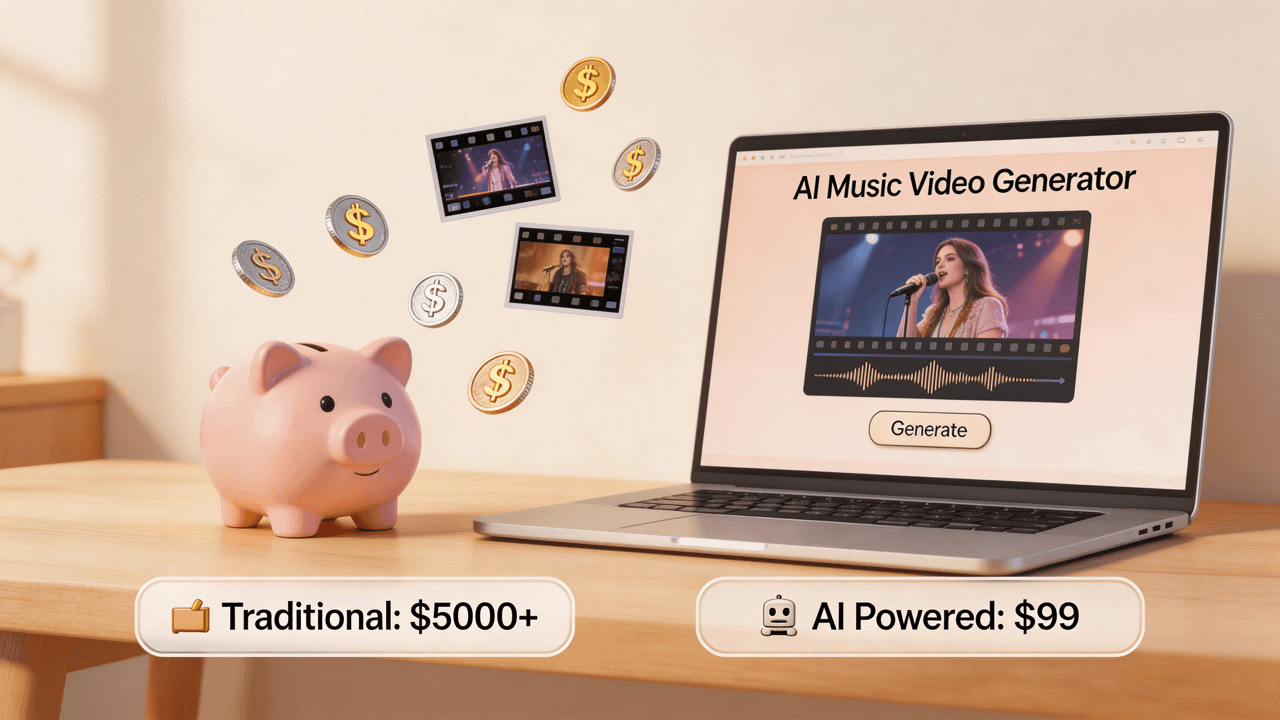
Cheapest Way to Make a Music Video in 2026
Compare the cheapest ways to make a music video in 2026, from free DIY editing to AI generation, freelance help, and traditional production. Use budget scenarios and VibeMV credit math.