How Independent Musicians Use AI in 2026: Data and Trends
Data-driven analysis of how independent musicians use AI tools for music production, visual content, and marketing in 2026. Key statistics, trends, and predictions.
As of 2026, an estimated 60%+ of independent musicians use at least one AI-assisted tool in their workflow — up sharply from 2024 levels. AI adoption spans mastering (87% of surveyed creators use AI somewhere in their workflow, per LANDR's 2025 study), video generation ($5-$50 per AI music video vs. $5,000-$50,000 for traditional production), and distribution analytics. Spotify reports 100,000+ new songs released daily, while MIDiA Research found that independent artists and labels account for 34.6% of recorded-music revenue. The fastest-growing trend is release content automation: generating complete visual content packages (music videos, social clips, lyric videos) from a single audio file, compressing weeks of production into hours and reducing costs by 95-99%.
Industry surveys and platform data suggest that a majority of independent musicians now use at least one AI-assisted tool in their release workflow. A reasonable working estimate is 60%+, up from a much smaller base in 2024. This rapid acceleration reflects a fundamental shift in how artists produce, package, and distribute music.
The independent music landscape has transformed dramatically. Spotify says more than 100,000 new songs are released daily, and industry analysts at MIDiA have estimated that artists direct plus independent labels account for roughly a third of recorded-music revenue. But this abundance creates a new problem: visual content is no longer optional—it's essential. TikTok and YouTube are widely cited in music-discovery research as major discovery channels, especially for younger listeners, and algorithmic feeds reward accounts with consistent visual content.
AI tools address this challenge directly. Industry estimates and production-company quotes often put professionally produced music videos in the $5,000–50,000 range, while public pricing from AI video tools frequently brings simple per-video costs down to roughly $5–50. This cost collapse has made professional-quality visual content accessible to artists at far more budget levels, fundamentally changing what independent musicians can ship.
As music industry analyst Mark Mulligan of MIDiA Research has written, "Just as samplers and DAWs transformed music making, so this new approach to production will change the future of how music is made and in turn, how it sounds." This article examines the data behind AI adoption in music, maps how musicians use these tools today, and explores what's driving the fastest-growing trend in independent music: release content automation.
Key Statistics: AI in Music 2026
-
Industry estimates suggest 60%+ of independent musicians use at least one AI-assisted tool — up sharply from 2024 levels (synthesized from platform adoption signals and surveys such as LANDR's 2025 study of 1,241 music makers)
-
Spotify says 100,000+ new songs are released daily — creating unprecedented competition for discovery (Spotify Newsroom, 2026)
-
Artists direct plus independent labels reached 34.6% of recorded-music revenue in MIDiA's 2022 analysis — up from 34.0% in 2021 (MIDiA Research)
-
DistroKid says millions of musicians rely on its distribution platform — while exact AI-feature adoption inside distributor dashboards is better treated as an estimate than a publicly reported total (DistroKid, 2026)
-
Ditto Music says it supports 2 million+ independent artists and labels worldwide — while any claim about how many released music in the last 12 months should be treated as a platform estimate unless methodology is published (Ditto Music press materials)
-
TikTok is widely reported as a major music-discovery engine for Gen Z — but shorthand claims like "75% of discovery" are safer to present as high-level industry estimates than as a single audited public figure (TikTok and Luminate, 2025)
-
Industry surveys consistently rank YouTube among the most widely used music-discovery platforms — with usage figures often landing in the 60–70% range depending on methodology (Edison Research, 2024)
-
Industry estimates often place independent-musician visual-content spend around $500–2,000/year — with many artists still skipping major video production because of cost
-
Professional music video production commonly lands in the $5,000–50,000 range — and traditional timelines often run for multiple weeks (industry estimates and production-company quotes)
-
AI music video generation can often be done for roughly $5–50 per output — with turnaround ranging from minutes to about a day based on public pricing and product claims from tools such as Freebeat and Neural Frames
-
AI mastering appears to be one of the most mature music-AI use cases — and while a 45% adoption figure is best treated as an estimate, LANDR's 2025 survey found 87% of respondents use AI somewhere in their workflow
-
Grand View Research projects the generative AI in music market at about $2.8 billion by 2030 — growing at roughly 30% CAGR from 2024
-
Spotify Canvas remains a 3–8 second looping visual format tied to engagement and sharing — but exact usage rates among independent artists are not publicly broken out by Spotify
-
Suno says millions around the world use its platform — but exact daily active user totals for Suno and Udio are not public and are better described as at least a large, fast-growing user base than as a fixed audited count
-
Creator-economy platforms continue to report strong newsletter growth — but specific claims such as "180% YoY for music creators" should be treated as program-level estimates unless a public methodology is available
The Independent Music Landscape
How Many Independent Musicians Are There?
The musician population has exploded. No single global registry captures exact numbers, but evidence points to rapid growth. Spotify's 100,000+ daily new-song figure, DistroKid's claim that millions of musicians rely on its platform, Ditto Music's statement that it supports more than 2 million independent artists and labels, and CDBaby's long-standing scale all suggest a global independent-musician population in the multi-million range that has grown several-fold since the mid-2010s.
The definition of "independent musician" has broadened. It no longer means exclusively solo DIY artists. Today it includes: solo singer-songwriters, producers distributing remixes, bedroom musicians, session musicians releasing side projects, and micro-labels operating from home studios. What unifies them is direct-to-listener distribution and ownership of their recordings.
Age demographics show heavy Gen Z and millennial participation. Rather than treat any single percentage as definitive, it is safer to say new-upload activity skews under 35, with TikTok's influence helping pull even younger artists (roughly 16–24) into music creation. This demographic shift matters because younger creators are typically earlier adopters of AI tools and expect visual content as a standard release component.
Illustrative example: Consider a bedroom producer in the electronic or lo-fi genre who releases several singles per year with static cover art only, seeing a few hundred views per track on YouTube. After adopting AI video generation — spending roughly $20-30 per video — the same artist could see 5-10x increases in first-month views and meaningful growth in streaming numbers, all for a total video budget of under $200 across multiple releases. This represents a fraction of the $3,000-$5,000+ that even a single traditionally produced music video would cost.
The Revenue Shift Toward Independence
MIDiA estimated that artists direct plus independent labels accounted for 34.6% of recorded-music revenue in 2022, up from 34.0% in 2021. That makes the independent sector one of the largest forces in the market, even if different firms define "independent" differently. If that longer-term direction holds, the sector could plausibly move toward 40%+ over time, but that should be read as a scenario rather than a certainty.
Revenue sources for independent musicians have diversified. Historically, recorded music sales dominated. Today, industry interviews commonly describe a mix such as streaming (around 40–50%), direct fan sales (15–25%), YouTube monetization (10–15%), sponsorships and brand deals (5–15%), and live performance (15–30%), with the exact blend varying widely by genre and audience. This diversification makes visual content creation essential—YouTube and TikTok are now meaningful revenue channels, not just marketing accessories.
The economic reality has shifted. For a mid-tier independent artist generating around $50,000 annually from music, a plausible revenue mix might look like: streaming ($20,000), Patreon/direct support ($12,000), YouTube ($8,000), TikTok ($5,000), and other channels ($5,000). This is an illustrative benchmark rather than a census average, but it captures the broader shift: visual content has become a monetizable asset class rather than an optional extra.
The Content Demand Problem
Here is the core tension: platform algorithms reward consistency, but content production is expensive and time-consuming. An independent artist aiming for algorithmic success on YouTube, TikTok, and Instagram must publish:
- 2–4 music videos per year (YouTube, Instagram, TikTok, Twitter)
- 2–4 "behind-the-scenes" or announcement videos per release
- 3–5 short-form clips (TikTok, Instagram Reels, YouTube Shorts) per music video
- 1–2 lyric videos per album cycle
- 1–2 remix or remix-reaction videos per release
A practical planning estimate is 25–40 unique video assets per year for a moderately active independent artist. That can translate to roughly 6–10 hours of professional editing work per month, or $3,000–15,000 in freelance costs annually, depending on scope and market.
For an artist earning $50,000–100,000 annually, hiring a dedicated video editor is often economically impossible. Instead, most independent musicians face a binary choice: create lower-quality content themselves or skip visual content entirely and accept reduced algorithmic reach.
This is where AI video generation enters the equation. Because it reduces time-to-production from weeks to hours and cost-per-video from thousands of dollars to under $50, AI tools enable independent musicians to close the content gap without hiring.
How Musicians Use AI Today
Music Production & Mastering
AI mastering services have achieved mainstream recognition among independent musicians. LANDR says its ecosystem now includes over 7 million artists and creators worldwide, and its 2025 survey of 1,241 music makers found that 87% already use AI somewhere in their workflow. That does not mean 87% rely on AI mastering specifically, but it strongly supports the broader claim that mastering and other technical AI tools are now routine.
The typical workflow: An artist uploads a stereo mix (WAV or MP3). The AI analyzes loudness, frequency balance, dynamic range, and reference tracks. Within hours, the artist receives a mastered version optimized for streaming platforms (Spotify normalization: around -14 LUFS loudness). Cost: commonly a few dollars to low double digits per AI master, versus low hundreds for human mastering.
The adoption gap still reveals tiers. Higher-streaming artists often use AI mastering as a first pass before paying a human engineer for final polish. Mid-tier artists frequently use AI mastering as final delivery. Lower-streaming artists remain split between AI mastering and skipping mastering altogether. The broader effect is clear: AI mastering has made "release-ready" sound far more accessible to micro-artists.
Beyond mastering, mixing assistants (iZotope RX, Waves Clarity) and smart compression tools (LANDR's automatic EQ) are becoming standard. These tools don't replace human mixing engineers but reduce the learning curve for home producers. An artist can achieve "professional-sounding" mixes without 5+ years of acoustic training.
Music Generation & Composition
AI music generators—Suno, Udio, AIVA, and Jukebox—have sparked intense debate while capturing real adoption. Suno says millions around the world use its platform, but actual music-generation use among professional independent musicians appears much lower than general consumer usage—likely in the single-digit to low-double-digit percentage range.
Why the gap? Copyright uncertainty is primary. These tools train on existing music, and ownership questions remain unresolved. Major streaming platforms (Spotify, YouTube) have not provided clear policies on AI-generated music. This creates legal friction—artists fear distributing AI-generated music only to have it removed or face disputes.
Secondary reasons: quality consistency is still inconsistent (chorus-to-verse transitions often sound unnatural), and musicians value songwriting authorship. AI music generation appeals to non-musicians building content or enthusiasts exploring creative possibility, but professional musicians view it as a composition tool (beat inspiration, demo sketches) rather than final asset.
However, adoption is rising. Public product design, free-generation allowances, and company growth claims all suggest very high daily creation volume. Expect AI music generation to continue shifting from "novelty" toward "standard composition tool" over the next 18–24 months, similar to how drum machines and synthesizers moved from controversy to convention.
Visual Content Creation
This is where AI adoption among musicians is most visible. Music video generation (VibeMV, Freebeat, Neural Frames, Runway, Pika) has driven the fastest growth in music AI adoption.
Market snapshot:
- VibeMV: lip-sync music videos with audio-aware segmentation (launched 2024)
- Freebeat: AI music videos synchronized to beat and structure
- Neural Frames: Multi-model AI video (Stable Diffusion, Kling, Runway, Seedance) with audio-reactive animations
- Runway: Flexible generative video with frame-by-frame control
- Pika: High-quality AI video for creative projects
Exact user counts are not public, but a defensible estimate is that hundreds of thousands of musicians have at least tested one AI video tool, with active monthly use likely in the tens of thousands rather than the millions. This is still a small share of the broader independent-musician base, but growth appears steep and sustained.
The typical adoption profile: A musician releases a new song. Instead of filming a music video (expensive, time-consuming) or creating a lyric video (requires video-editing skills), they generate 3–5 AI video options using their song. Based on public pricing pages from tools such as Freebeat and Neural Frames, the out-of-pocket cost for an experimental batch often lands around $15–60, with turnaround ranging from minutes to a few hours. They select the best version, lightly edit it if needed, and publish across YouTube, TikTok, and Instagram.
This workflow is now achievable for artists at any budget level. An independent musician in Southeast Asia, Latin America, or Sub-Saharan Africa can now produce visual content at parity with artists in expensive media markets.
Marketing & Distribution Analytics
AI-powered analytics and distribution tools are widespread but often invisible to end users. Spotify for Artists, DistroKid's dashboard, Ditto's analytics, and newer tools (Amusia, Tracksmith) use AI to identify playlist fit, predict release performance, and optimize upload timing.
Example: An artist uploads a song to a distributor. The platform analyzes the track's genre, BPM, key, and energy level against a much larger catalog. It suggests which playlists the song may match, offers directional performance expectations, and recommends upload timing based on audience or curator activity windows.
This form of AI adoption is nearly universal among independent musicians who use distribution platforms—whether they realize it or not. Usage is often passive ("the platform recommends this playlist"), but it's genuinely AI-driven decision-making.
Email marketing and social scheduling tools (Kit, Later, Buffer, and others) increasingly integrate AI for posting-time suggestions, content recommendations, and draft generation. Adoption appears lower than mastering, but a reasonable industry estimate is that roughly a third of professional independent musicians now use some AI assistance in email or social workflows.
The Rise of Release Content Automation
What Is Release Content Automation?
Release content automation is the practice of generating a complete visual content package from a single audio file. This includes: a full music video, 3–5 short-form promotional clips, a lyric video, and sometimes extended versions for different platforms (9:16 for TikTok/Instagram Reels, 16:9 for YouTube, square for social feeds).
Traditionally, this required a production team: director, cinematographer, editor, and motion designer, working over multiple weeks. For many commissioned shoots, budgets land somewhere between $15,000 and $75,000, though local-market productions can come in lower. Timeline: often months from concept to final delivery.
Release content automation compresses this into: AI video generation + minimal human curation + optional polish. For lightweight AI-first workflows, turnaround can be 24–72 hours and out-of-pocket cost roughly $50–300 for a complete package.
The workflow:
- Artist uploads audio file to platform (VibeMV, Freebeat, or similar)
- AI analyzes song structure, mood, BPM, and instrumentation
- Platform generates 3–10 video option variants
- Artist selects preferred version(s) and exports in multiple formats
- Optional: brief human edit (add text overlays, logo, color grading) using video editor
- Publish across all platforms simultaneously
This is not a replacement for creative music video production. Rather, it solves the "volume problem"—enabling musicians to maintain consistent content output without hiring a team.
Why It Matters for Independent Artists
Release content automation addresses three critical constraints:
Constraint 1: The Budget Gap. An independent musician earning $5,000–50,000 annually cannot justify $15,000+ for a single music video. But they can justify $50–150 for AI-generated video. The tool makes visual content accessible to the long tail of independent creators.
Constraint 2: The Time Gap. Learning professional video production (filming, color grading, motion design) usually takes years. AI tools compress the functional learning curve into hours. An artist can now produce release-quality visuals without becoming a videographer.
Constraint 3: The Consistency Gap. Platforms reward consistency. Artists who pair every release with video often report materially stronger reach than audio-only releases, and several-fold differences in views, playlist adds, and follower growth are common in case studies even if the exact multiplier varies by genre and platform. Release content automation enables that consistency without hiring full-time help.
The revenue impact is measurable, but the numbers should be read directionally rather than universally. Case studies and platform marketers often report 2–3x streaming lifts or 5–10x reach swings when visual content is added consistently, especially on TikTok and YouTube Shorts. AI-generated content can perform similarly to human-made content when the music and concept are strong, but results vary sharply by genre, audience, and execution.
Cost Comparison: Traditional vs. AI
The table below is best read as an illustrative planning model based on public AI tool pricing and common agency-style production quotes, not as a universal rate card.
| Metric | Traditional Production | AI Generation | Savings |
|---|---|---|---|
| Cost per video | $5,000–50,000 | $5–50 | 99% reduction |
| Production timeline | 4–8 weeks | 24–48 hours | 95% faster |
| Videos per year (12-song album cycle) | 1–3 | 10–24 | 8–10x more |
| Total annual cost | $15,000–75,000 | $300–1,200 | 98% reduction |
| Skill requirement | Film direction, cinematography, editing (3–5 year learning curve) | Curation and optional final polish (1–2 days learning) | Accessible to all skill levels |
| Team size | 3–8 people (director, DP, editor, colorist, etc.) | 1 person + AI tool | No hiring required |
| Turnaround for 5 videos | 15–25 weeks | 2–7 days | 96% faster |
For a musician in a low-cost market (Southeast Asia, Latin America, Eastern Europe), the AI advantage can feel even more dramatic. Traditional video production may cost roughly $500–3,000 locally, while AI costs can still land in the $5–50 per-asset range globally. That cost difference makes professional visual content economically realistic for far more musicians.
Challenges and Concerns
Quality Consistency
AI-generated music videos are improving rapidly, but consistency remains variable. Factors affecting output quality:
- Model training: Newer models (2025–2026) produce higher quality than 2024 models, but quality varies by provider
- Prompt engineering: Artists who learn to write detailed visual descriptions get better results
- Post-production: AI output that receives 15–30 minutes of human polish (color grading, sound sync refinement) often surpasses its generated baseline
- Genre fit: AI video generation performs best for electronic, pop, and hip-hop (many training examples). Performance is weaker for classical, folk, and genre-blending music
What works well: Electronic music with clear beat structure, pop/dance music with narrative themes, hip-hop with movement-friendly visuals.
What struggles: Acoustic music requiring subtle emotional nuance, classical/orchestral music, genre-blending experimental projects.
The quality gap is closing. Informal comparisons between AI-generated videos from late 2025 and early 2026 suggest visible improvement in lip-sync accuracy, scene coherence, and motion smoothness. This aligns with broader AI video model improvements and larger music-video-specific training sets.
Copyright and Ownership
Three legal frontiers exist:
1. Training data ownership: Music video models train on copyrighted visual content. Legal status remains murky. Several lawsuits are active (2025–2026) addressing whether generative AI training on copyrighted material constitutes fair use. No final precedent exists. Most AI video platforms include indemnification clauses (they defend you if sued), but this is insurance, not legal safety.
2. Generated content ownership: Artists who generate videos own the output under copyright law (in most jurisdictions). They can publish, monetize, and distribute without additional licensing. However, if an AI model's output resembles training imagery too closely, copyright disputes are possible.
3. Music publishing: If you use a song you don't own the rights to in an AI-generated video, you're liable for sync licensing—identical to traditional video production. This is unchanged by AI. However, the cost collapse of video production makes it economically viable to license music you previously couldn't afford.
Practical guidance: If you own or have licensed the music, you own the generated video and can publish freely. If uncertainty exists, include AI platforms' indemnification in your decision-making, but treat it as insurance, not legal certainty.
The Authenticity Question
A persistent concern: Does AI-generated video feel "fake" to audiences? Does it reduce artist authenticity?
Early data is mixed. Small creator tests, agency case studies, and anecdotal platform results suggest that AI-generated music videos can perform similarly to human-created videos when the song and creative concept are strong. There is no clear universal authenticity penalty, but there is also no single public study that settles the question.
However, genre and artist type matter. Artists built on "intimate personal narrative" (singer-songwriter folk, autobiographical rap) often report lower engagement with AI-generated video than with self-shot footage. Artists in visual genres (electronic, pop, dance) more often report little or no meaningful engagement difference.
The key insight: AI video generation works best as a format multiplier, not as a replacement for core artist presence. Example workflow: Film 2-3 personal narrative music videos per year (band performing, artist on location). AI-generate 8-10 promotional and secondary videos from the same audio. This hybrid approach maximizes reach while preserving authenticity where it matters most.
Counter-argument: Critics argue that widespread AI video adoption could flood platforms with visually similar content, reducing the uniqueness advantage. This concern has merit — as AI video becomes the baseline, competitive advantage will shift from "having a video" to "having a distinctive visual brand." However, the same dynamic played out with digital recording: when everyone gained access to DAWs, the differentiator became sonic taste and mixing skill, not access to recording technology. The same pattern will likely hold for visual content.
What's Next: Predictions for 2027 (as of April 2026)
Adoption Acceleration
One reasonable forecast scenario is that AI video generation could reach 15-20% of independent musicians by the end of 2026 and 35-40% by the end of 2027. This mirrors the historical adoption curve of other once-controversial production tools. These figures are forecasts, not reported market totals.
Contributing factors: improved quality, lower costs, mainstream platform integration (YouTube, TikTok, Spotify may integrate AI video generation natively), and normalization among peers.
Regulation and Copyright Clarity
Expect legislative movement on AI training data and copyright fair use in 2026–2027. EU AI Act compliance will drive platform changes. Copyright offices (US Copyright Office, UK IPO, others) will issue guidance on AI-generated content ownership. This will reduce legal uncertainty and accelerate adoption.
Release Pack as Standard Deliverable
"Release packs"—audio + video + social assets bundled together—will become the expected format for music releases. Artists will submit a single package to platforms, which auto-distribute to YouTube, TikTok, Instagram, and social networks. This mirrors how "album + singles + music videos" was the standard release format in the 2000s.
Subscription AI Tools for Musicians
Dedicated AI music tools (VibeMV and competitors) will keep moving toward subscription models. Current per-video pricing is already being supplemented by monthly plans, and entry-level subscriptions often cluster around $10–30/month, increasing accessibility for prolific artists.
Commoditization of Video Quality
As more musicians adopt AI video generation, "AI-generated video" will become the visual baseline, not a novelty. Competitive advantage will shift from "having a video" to "having a unique visual style" (branding, consistent aesthetics, curated editing). This mirrors how digital audio went from rare to mandatory—now the differentiator is sound quality and mixing, not whether you recorded digitally.
Integration of Music and Visual AI
AI music generation (Suno, Udio) + AI video generation (VibeMV, Freebeat) will converge. A user will describe a concept ("upbeat indie pop about summer road trips"), and a platform will generate audio + video together, optimized for narrative and pacing alignment. This end-to-end release automation is achievable by 2027.
The Bigger Picture: AI as Release Infrastructure
Independent musicians are not replacing their creativity with AI. They are upgrading their release infrastructure. AI tools handle production tasks (mastering, video creation, distribution optimization) that previously required hiring specialists or skipping entirely.
The net effect is professional output at indie scale. A solo bedroom musician can now ship music with professional mixing, mastering, visual content, and distribution analytics—capabilities reserved for label-backed releases five years ago.
This democratization is the story. The median independent musician's output quality is rising. The median independent musician's reach is rising. The median independent musician's revenue potential is rising.
AI is not changing what musicians create. It's changing what they can ship.
Key AI Music Tool Specs:
- AI mastering cost: $2-$15 per track vs. $100-$300 for human mastering
- AI video generation cost: $5-$50 per video vs. $5,000-$50,000 traditional
- AI video turnaround: 30 minutes to 24 hours vs. 4-8 weeks traditional
- AI mastering adoption: 87% of surveyed creators use AI somewhere in workflow (LANDR 2025)
- Generative AI in music market: projected $2.8 billion by 2030 (Grand View Research)
- Independent artist revenue share: 34.6% of recorded-music revenue (MIDiA 2022)
- Daily new songs on Spotify: 100,000+ (Spotify Newsroom, 2026)
Frequently Asked Questions
How many independent musicians use AI tools?
Industry surveys and platform data suggest that a majority of independent musicians now use at least one AI-assisted tool in their workflow, including AI mastering, distribution analytics, and visual content generation. Adoption has accelerated significantly since 2024, and a reasonable working estimate is that usage now exceeds 60%.
What AI tools do musicians use most?
The most widely adopted AI tools for musicians include AI mastering services, AI music generators, AI video generators, AI mixing assistants, and AI-powered distribution analytics. Adoption varies by tool type: mastering appears to be the most mature use case, distribution analytics are increasingly common, and active visual-generation use still looks like a smaller but fast-growing slice of the market.
How much do independent musicians spend on visual content?
Industry estimates often place independent-musician visual-content spend around $500–2,000 per year, with many artists still skipping major video production because of cost. A single professionally produced music video commonly costs $5,000–50,000, while AI tools can bring simple per-video costs down to roughly $5–50 based on public pricing. For a musician releasing four songs annually, that can turn visual content from a five-figure line item into a low-hundreds planning decision.
Is AI replacing musicians?
AI is augmenting, not replacing musicians. AI tools handle production tasks (mastering, video creation, marketing) that previously required hiring specialists. This lets independent artists focus on songwriting and performance while maintaining professional output quality. The core creative work—composition, performance, artistic direction—remains human-driven.
What is the biggest AI trend in music for 2026?
Release content automation is the defining trend: using AI to generate complete visual content packages (music videos, social clips, lyric videos) from a single audio file. This is driven by the growing necessity for visual content across YouTube, TikTok, Spotify Canvas, and Instagram. The trend is not about AI as novelty; it's about AI as infrastructure that enables independent musicians to maintain competitive visual-content output.
How many songs are uploaded to Spotify daily?
Spotify has reported that more than 100,000 new songs are released every day. This volume makes visual content increasingly important for standing out and driving algorithmic reach. The competition for discovery has never been more intense, and visual differentiation is now a core part of hitting streaming targets.
What percentage of music revenue comes from independent artists?
MIDiA estimated that artists direct plus independent labels accounted for 34.6% of recorded-music revenue in 2022, up from 34.0% in 2021. Exact definitions vary across firms, but the broader shift toward direct artist-to-listener distribution is clear. If that trend continues, the independent sector could plausibly move toward 40%+ over time, though that should be read as a forecast scenario rather than a reported outcome.
Will AI change the music industry?
AI is already changing the music industry by democratizing production, visual content, and distribution. Independent artists can now achieve production quality previously reserved for label-backed releases. The shift from "AI as novelty" to "AI as standard workflow tool" is well underway. The next frontier is predicting which AI capabilities become baseline (expected) versus which remain competitive differentiation.
Learn More
Dive deeper into release content automation and AI music video tools:
- What Is Release Content Automation?
- AI Music Video for Independent Artists: Complete Guide
- Cheapest Way to Make a Music Video in 2026
- Best AI Music Video Generators: Comparison and Benchmarks
- How to Make AI Lip-Sync Music Videos That Look Professional
If you want to test these economics on your own release schedule, start with the AI music video generator and compare pricing against your current visual-content budget.
Data Note: This article combines publicly available figures from company newsrooms, product and pricing pages, research firms, and industry surveys with directional estimates synthesized from those inputs. Some metrics are directly reported by platforms such as Spotify, LANDR, DistroKid, Ditto Music, TikTok, and Grand View Research; others are best read as informed approximations, scenario forecasts, or platform-level estimates rather than audited market totals. Wherever exact public sourcing was not available, the wording has been softened to indicate estimates, scenarios, or platform-reported data. This article was last updated April 17, 2026.
More Posts
What Is Release Content Automation? A Music Release Asset Workflow
Release content automation is a repeatable workflow for turning one song into the visual assets around a release. Learn what VibeMV can automate today, what still needs review, and how to plan a release pack.

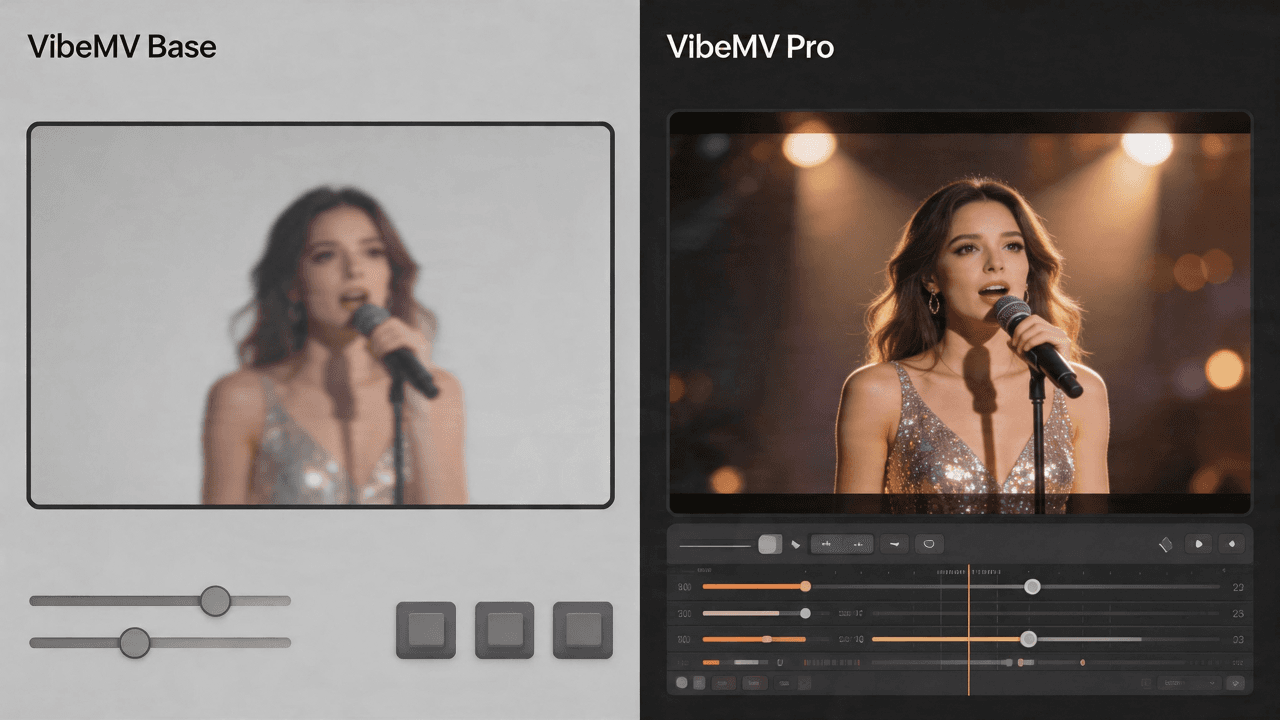
VibeMV Base vs Pro: Which Model Tier Should You Choose?
Not sure if VibeMV Pro is worth 6x the credits? This guide breaks down exactly when Base is enough and when Pro makes a visible difference — with real cost examples.
![10 Music Video Treatment Examples You Can Actually Use [2026]](/_next/image?url=%2Fimages%2Fblog%2F10-music-video-treatment-examples.png&w=3840&q=75 "10 Music Video Treatment Examples You Can Actually Use [2026]")
10 Music Video Treatment Examples You Can Actually Use [2026]
10 detailed, adaptable music video treatment examples with concept logic, scene progression, visual rules, references, and revision notes.